Search This Blog

Total Pageviews

Saturday, June 25, 2011

6/25/11 KAYAKS AND GARDENS

KAYAKS AT GARDEN VIEW 

A GARDEN OF KAYAKS

ORANGE HAWKWEED
6/25/11: Saturday, 8:30 AM.  64 degrees, wind W, calm.  The sky is partly overcast and the atmosphere is hazy, but the barometer is up and it will be a nice day.
    We have kayakers as guests in Garden View, and their four kayaks are very  colorful, matching the flowers of the garden. It will be a fine weekend for kayaking,.
    Orange Hawkweed, Hieracium aurantiacum, is a composite flower with a rosette of basal leaves,  and is very common in lawns and other grassy spots in our region.  It is quite pretty but also somewhat weedy.  It was naturalized from Europe with early settlement.
    I’ve started to catch up with lawn mowing and such but it will take a few days to do so after our week of rain.

Friday, June 24, 2011

6/24/11 LOTS OF POLLEN, RIPENING FRUIT, AND SUNSHINE

FIFTY-FIFTY SKY

AMERICAN VETCH

RIPENING JUNEBERRIES

CONCOLOR FIR POLLEN CONES
Friday, 8:15 AM.  58 degrees, wind variable, changing from NW to W, very gusty.  The sky is cloud covered in the north and east, clear in the west.  The barometer is up and a high is moving in at last, after seven days of rainy weather.
    Juneberries, Amelanchier canadensis,  are ripening, the trees and bushes loaded with fruit.  It should be a great year for apples as well.  The birds and animals will get most of the Juneberries as they are small and hard to pick, although quite good.
    American vetch, Vicea americana, is blooming in the fields and roadsides now, straggly but quite pretty.
    All the conifer species are ready to release their pollen if they have not already done so.

Thursday, June 23, 2011

6/23/11 FORTY DAYS AND FORTY NIGHTS


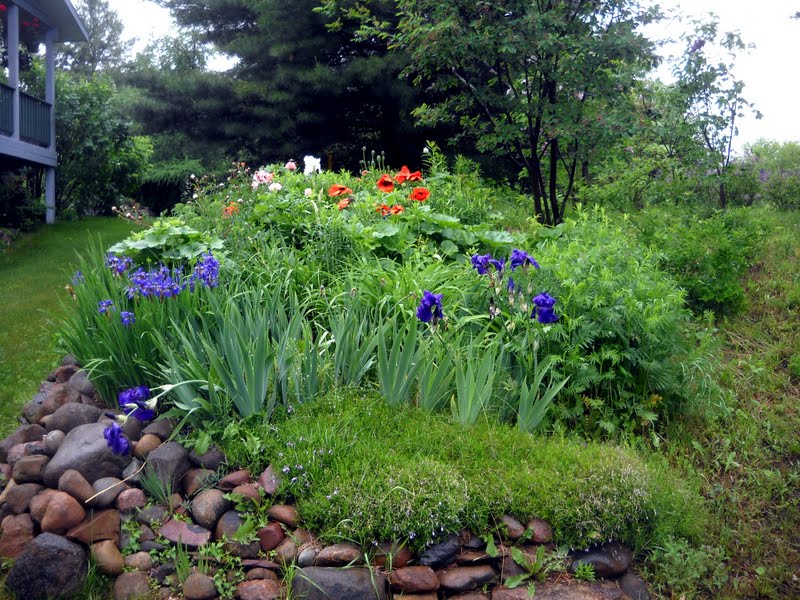
THE OLD GARDEN LOOKS PRETTY GOOD
CLEMATIS
DWARF DOGWOOD, AKA BUNCHBERRY
BLUM ROAD IN HEAVY FOG
Thursday, 8:30 AM.  48.5 degrees, wind SE, light.  It is still raining lightly, the sky is overcast and it is foggy, but the barometer predicts partly cloudy skies and with the wind shift we may have a high coming in that will break this spell of wet, cold weather.  The big freighter was still moored off Madeline Island yesterday.  Could it be Noah’s ark? Actually, it may have just delivered coal to the Ashland power plant. Anyway, we are nowhere near forty days and forty nights of rain, although it feels like it.
    The overgrown garden has become quite beautiful with Iris, lilies, poppies, and peonies about to burst into bloom.  Clematis are blooming too, and there are still some lilacs.  The tomatoes are just sitting here shivering.
    Dwarf dogwood, or bunchberry, Cornus canadensis, are blooming profusely along Blum road, which was enveloped in fog yesterday afternoon.
COULD IT BE NOAH'S ARK?

Wednesday, June 22, 2011

6/22/11 RUNNING FOR A LEE

LYING IN THE LEE
WHITE PINE POLLEN CONES
BRIDAL WREATH SPIREA

Thursday, 7:00 AM.  48 degrees, wind ENE, strong.  It rained all night and is still raining after having gotten over an inch, as the barometer predicts more.  Madeline Island is enshrouded in fog.  We are still in the grip of a Nor’easter. Our travelers going back to Texas reported tornadoes in Nebraska and Kansas, and very hot weather.
    A large freighter (but not a “thousand footer”) spent time waiting out the storm yesterday in the lee between Madeline Island and Long Island.  I can’t see if it is still there this morning
The male cones of the white pines are bursting with pollen, and as soon as we get a drying wind the air will be filled with clouds of the yellow dust and I will have a stuffy nose again.
    The old fashioned bridal wreath Spireas are blooming all over town, gracing the fronts of Nineteenth-century homes.

Tuesday, June 21, 2011

6/21/11 SMALL, FLOWERING MAPLES, AND RECALL CAMPAIGNS

MOUNTAIN MAPLE

...FLOWERS

GINALLA MAPLE

...FLOWERS
Tuesday, 7:45 AM.  51.5 degrees, wind NE, light with stronger gusts.  The sky is overcast and it is raining .  The barometer predicts more rain.  It is the first day of summer and it feels almost like the first day of spring.
    The mountain maple, Acer spicatum, is blooming now, its erect panicles of greenish flowers poking up through the round, rather large, slightly three lobed leaves.  It is native to southern Canada and the US northeast, and far upper Midwest around the lakes, but seems rather rare in our area.  In habit it is a multi-trunked small under story tree or large shrub.  It’s leaves turn a brilliant orange-red in fall.  It is seldom seen in landscaping and the nursery trade.
    An oriental counterpart is the Ginalla maple, Acer ginalla, which also has greenish flowers, rather insignificant but numerous, and small, lobed, typically maple, leaves.  It is probably over used, but it does have excellent red and orange fall color. Another oriental maple, the hedge maple, Acer campestre, is somewhat similar in shape and  has good yellow fall color.
    Politics: Recall campaigns targeting both Democrat and Republican Wisconsin state senators and representatives are  underway.  It seems our society no longer accepts winning and loosing as an end to political conflict, but seeks to have a constant campaign amid ideological warfare.  Not a way to accomplish anything, or to foster democracy. Whatever happened to majority rule with minority rights? What’s next, sabotage and street battles?

Monday, June 20, 2011

6/20/11 SOME SPECTACULR FLOWERING TREES

RUBY RED HORSECHESTNUT

...FLOWERS

FORT MCNAIR BUCKEYE

...FLOWER

PAUL'S SCARLET HAWTHORN

...FLOWERS

Monday, 7:45 AM.  55 degrees, wind N, light with stronger gusts.  The sky is hazy but mostly clear and the barometer is up, so it looks like it will be a fine day after a spate of cold, wet weather. I have a lot of yard work to do after things dry up.
    Several interesting trees are blooming now.  The hybrids between the horsechestnut, Aesculus hippocastanum, and the red buckeye, A. pavia are named A. x carnea, the x denoting a hybrid.  A number of selections have been made from this pairing, the most popular being the ruby red horsechestnut, A. x carnea ‘Brioti.’  It is a medium sized tree, rounded in form at maturity and very vibrant in flower.  Another is A. x carnea ‘Fort McNair’ a US National Arboretum introduction. It is somewhat smaller and more upright and by all accounts is a good smaller street tree.  Both are hardy in Zone 4, and seem to be doing well in Bayfield.  I planted a half dozen of ‘McNair’ on the S 6th St. entrance to town several years ago and they attract a lot of attention when in bloom. I have a hard time telling ‘Brioti’ and ‘McNair’ apart but I believe the one pictured, growing in a yard on N 4th St. is the former.
    Another tree that is spectacular in bloom is the English hawthorn selection Crataegus laevigata ‘Paul’s Scarlet,” which was once very popular but is very susceptible to fire blight and not seen much anymore.  The one pictured is in a small park on S 6th St. and Old Military, and does not seem to get fire blight.
    I am often asked why I do not use only native trees for the city streets, but that is a whole subject in itself which I will address at some time in the future.

Sunday, June 19, 2011

6/19/11 FAMILIES

HEADING HOME

THIMBLE WEED

PASQ UE FLOWER AND MEADOW R UE

MEADOW RUE

THIMBLE WEED FLOWER
Sunday, 9:00 AM.  52 degrees, wind NNE, light, with occasional strong gusts.  It is overcast and threatening rain, which we received about an inch of last night. Our Texas family, Dutch, Leslie and toddler Allison Eleanor (and Tango, their dog) left for home today, stopping to stay overnight in Lincoln, Nebraska with friends.  We will miss them, but will see them next winter in Texas, and time goes fast these days.
    We are pleased that this summer’s Sunday’s will be graced with services at our old Christ Episcopal Church.  I may even start ringing the bell again, like old times.
    Anemone canadensis, the thimble weed, is blooming. It is native to meadows and shores in the upper Midwest.
  Also blooming now is the meadow rue, Thalictrum dioica, native to the upper Midwest and the east coast in rocky woods, ravines and out washes. The interesting seed heads of  Anome patens, called Pasque flower or prairie smoke, are evident now.  All three plants are in the Ranunculaceae, the buttercup family, and are often grown in gardens.