Search This Blog

Total Pageviews

Saturday, March 22, 2014

NEEDLE BURN ON WHITE FIR, AND ENOUGH OF PRETTY ALREADY!

NEEDLE BURN ON WHITE FIR...

...CLOSEUP OF DAMAGE;
NOTE UPWARD SWEEP OF NEEDLES ON BRANCHES, WHICH IS TYPICAL OF FIRS)

NEW SNOW ON HEDGE MAPLE;
ENOUGH OF PRETTY ALREADY!!

Saturday, 9:00 AM.  10 degrees F, wind WNW, light to moderate with moderate gusts.  The sky is mostly clear except for some very high thin white clouds blowing in with the cold high pressure system.  The humidity is 72% and the barometer is rising, now at 30.34".  It is a pretty day, although chilly.
   The white, or concolor fir, Abies  concolor, is native to the mountains of Southwestern North America (Colorado to southern California, New Mexico, northern Mexico) and as a montane species adapted to the cold conditions of high elevations is hardy to Zone 3.  It grows best on rocky, well drained soils with ample moisture.  It does not tolerate clay very well.  The tree pictured has always looked good, but has a lot of needle burn from this winter.  Our native balsam firs do not seem to have been similarly damaged.  The concolor fir is rather broadly conical and has a blue to blue-green needle color that is much like that of the popular Colorado blue spruce, which has some problems of its own.  It is fine to plant such trees for their color, shape and texture, but be aware of their shortcomings.
   Firs can be easily identified by the upward curvature of their soft, non-prickly needles, and by their cones, which are held upright on the branches (spruce cones hang down).  The needles of the Douglas fir (which is not a true fir but a separate genus, Pseudotsuga) are attached to the branch horizontally, like those of yews (Taxus species).
   The new snowfall is very pretty, but enough already!

Friday, March 21, 2014

SPRING IS RELUCTANTLY ARRIVING: PUSSY WILLOWS,NESTING CROWS, AND OPEN WATER

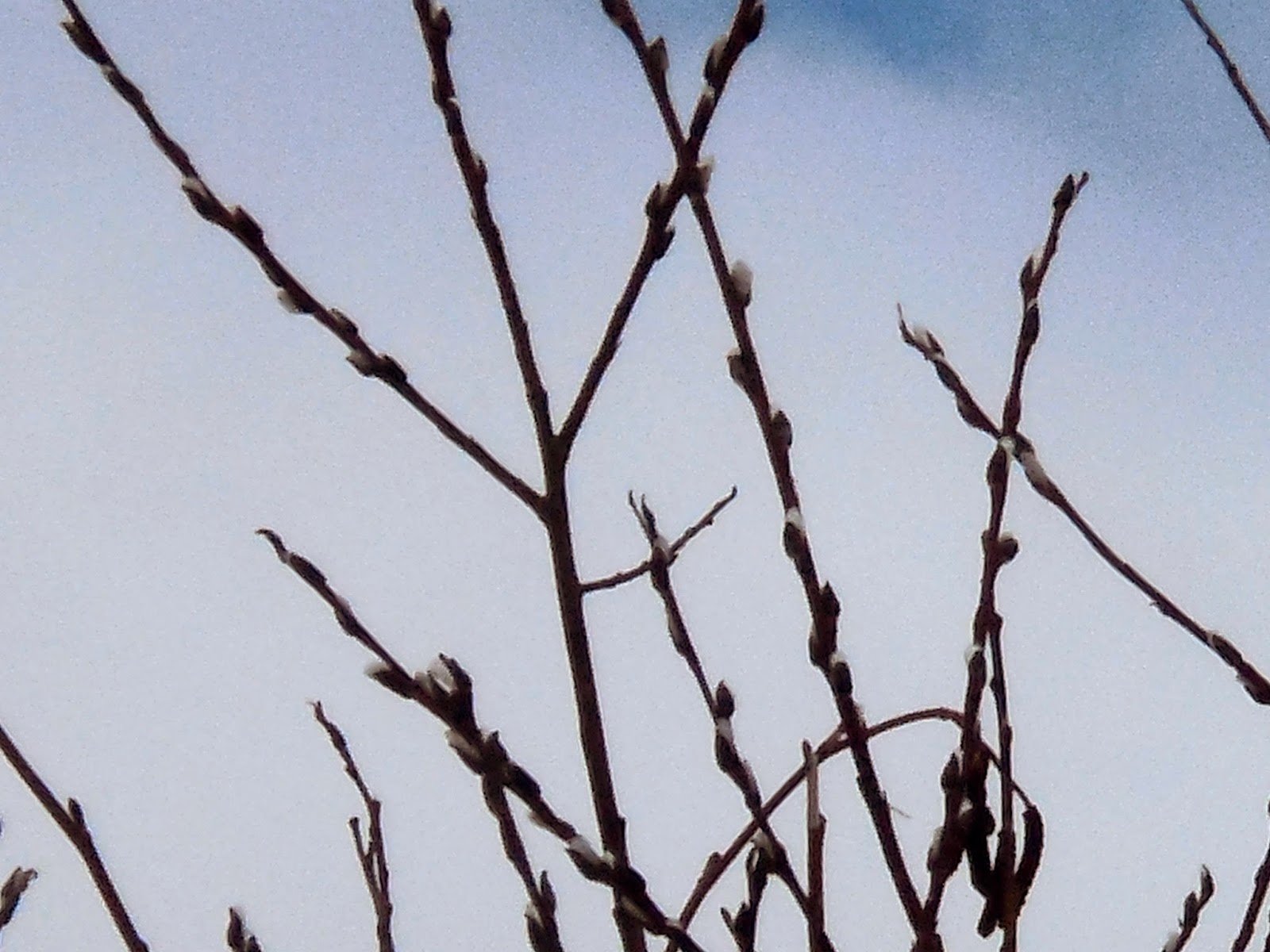
PUSSY WILLOW BUDS ARE BEGINNING  TO OPEN

THERE IS OPEN WATER NOW BEYOND MADELINE ISLAND
(as viewed from the top of Washington Ave)
Friday,  9:00 AM.  30 degrees F, wind WSW, calm to very light.  There is a high overcast, the humidity is up, to 81%, and the barometer is down, to 29.89".  We may get some precipitation.
   I checked out the native pussy willows, Salix discolor, at the beach yesterday and the buds are beginning to open, the white fluff inside now  clearly visible.
  The crows have been very active of late, and this morning I saw one flying with a twig in its beak, obviously engaged in building a nest.
   We were surprised yesterday to see that there is now a huge expanse of open water east of Madeline Island, where there was nothing but ice and snow only twelve days ago. The Ice Road won't last much longer.
   Spring is reluctantly arriving.


Thursday, March 20, 2014

...BUT ON THE OTHER HAND...

A GAP IN THE ARBORVITAE  HEDGE...

...AND LOTS OF WINTER BURN ON THE DWARF ALBERTA SPRUCE

THERE'S A RHODODENDRON GARDEN UNDER THERE SOMEWHERE...

...AN AZALEA POKING THROUGH THE SNOW
Thursday,  29 degrees F, wind WNW, light with stronger gusts.  The sky is overcast, the humidity is down to 72% and the barometer is up, now at 30.01".  At least it isn't snowing on this, the first day of spring, or ziigwan, as our neighbors would say in the Ojibwe language. 
   By all accounts this has been a rough winter.  Just how rough won't be apparent until after the snow melts and we can really examine the plants.  Not that it hasn't been plenty rough on heating bills, water lines and roads.  But plant-wise it's a little early to tell, although some things have obviously taken a hit, such as the arborvitae (Thuja occidentals) hedge in the back yard, which has many plants bent over by the snow load.  I hope they're not actually broken, and I have learned over the years not to try to brush the snow and ice off of heavily laden trees and shrubs, it invariably does more harm than good.
   And the dwarf Alberta spruce (Picea glauca 'Conica') in the herb garden, which are no longer 'dwarf', have experienced even worse winter burn than usual.  The needles often burn from wind and snow-reflected sun, but they recover with a flush of new growth.
   Some plants will actually benefit greatly from the deep snow cover.  The Rhododendrons and azaleas (both are in the genus Rhododendron, but the Rhododendrons have broadleaf evergreen foliage and azaleas are deciduous) are happy as can be under the snow.  Only one azalea is poking through, and the buds on it look quite viable.
   The perennial garden will fare well also, with plenty of insulating snow cover, little or no frost, and lots of moisture from the melting snow.
   So, on the one hand..., but on the other hand...

Wednesday, March 19, 2014

BAD ROADS, AND WORSE

WINTER RETURNED TO THE NORTHLAND WITH A VENGEANCE YESTERDAY...


...AND TO THE ICE ROAD 

WHEAT DRIED FOR HARVEST WITH ROUNDUP (GLYPHOSPHATE)

Wednesday,9:30 AM.  27 degrees F, up from 18 earlier.  The winD is NW, Light to moderate.  The sky is cloudy and it is  still snowing lightly after depositing 4"- 5" of new snow.  The humidity is 90% and the barometer is steady, at 29.85".
   Winter returned with a vengeance yesterday, and the roads were pretty treacherous.  I had a flat tire that needed repairing, and will ultimately result in purchasing a set of new tires for the truck, so I had to drive on bad roads to Ashland. The Ice Road looked worse.
   Traversing Wisconsin last fall I was amazed at all the obviously artificially dried fields of corn in the agricultural areas of the state.  Upon asking farmers and others who would know the reason, the consensus was that glyphosphate, specifically the weed killer Roundup, was being used extensively to treat the green corn so that it could be more easily distilled into ethanol.   I was astounded at this, as only the kernels are used to produce ethanol and the rest of the plant is used primarily in cattle feed.
   First, let me say that I think producing ethanol as a biofuel is a fools errand, as it takes almost as much energy to produce the ethanol as is derived from it as a fuel.  The whole enterprise is another expensive, dubious governmental boondoggle, resulting in 40% of the nation's corn crop, which arguably should be used for food for humans and animals, is now used to produce ethanol to enrich gasoline.  Even Pope John Paul, who was neither an economist nor a biologist, got this one right.  Will we never learn?
   Second, and perhaps more importantly, there is now considerable suspicion that glyphosphate used to dry crops (wheat as well as corn) and as an agricultural weed killer is finding its way into the human diet and causing the near  epidemic-like incidence of celiac disease, which is intolerance to dietary gluten.  The research on the causal relationship is perhaps rudimentary, but there seems to be a more than incidental connection between the two factors.
   We have had pesticide and herbicide panics in the past, such as the the concern about the use of Alar on apples, which have been unnecessarily damaging to agriculture and were overblown.
   But keep your eye on this issue.

Tuesday, March 18, 2014

KEEPING OUR FINGERS CROSSED

COULDN'T HURT, I GUESS...
...THAT'S PRETTY MUCH WHAT IS HAPPENING
Tuesday, 8:30 AM.  26 degrees F, wind variable, light.  The sky is overcast, it is snowing lightly; fine, icy crystals, of which about two inches has fallen.  Freezing fog enshrouds the channel.  The dusting of new snow covers up the ugliness of the deteriorating snow cover, but that's all I can say for it.
   The church on Hwy. 13 south of Washburn has an intriguing message posted on its information sign: "Pray for a slow melt down." Can't argue with the sentiment, and actually that's what we have been getting for several weeks now, so one might assume their entreaties are being answered.  Anyway I guess their efforts couldn't hurt.
   Another week or two of similar slow melting and we shouldn't have too many flooding worries (absent a repeat of last year's April and May storms that dropped about five feet of late snow on us).
   We'll keep our fingers crossed as well.

Monday, March 17, 2014

TROUT, DEER, MAPLE SAP AND HUNGRY BEARS

NORTH BRANCH OF PIKES CREEK IS RISING...THINK TROUT!

DEER ARE LOOKING FOR HERBS BENEATH THE SNOW  

MAPLE SAP IS RISING

AND THE BEARS ARE WAKING UP
Monday,  9:00 AM.  19 degrees F, wind SW, light to moderate with strong gusts.  The sky is overcast and a few snowflakes are blowing about.  The humidity is 82% and the barometer has fallen rather precipitously to 29.83". A city crew is thawing out a sewer main on tenth and Manypenny.  We have a return of winter this morning, which I hope  is only temporary.
   Things are waking up though, coming out of the winter doldrums.  The North Branch of Pike's Creek is beginning to look like a trout stream again; we are seeing deer looking for fresh forage every day now, the maple sap is flowing and the bears will soon be prowling about.  Hope ours aren't as hungry as the Russian Bear that has come out of hibernation and is gobbling up Ukraine.  Time to put my pistol in my coat pocket when out in the big woods, I guess.
   President Obama, please do not wander about in the Russian woods unless you do likewise.

Sunday, March 16, 2014

I SURE DO LIKE WATCHING BEAVERS

BEAVER POND AND DAM AT HEADWATERS OF THE NORTH BRANCH OF PIKE'S CREEK...

...LOCATED IN A MARSH ALONG VALLEY ROAD...

...LOOKS LIKE THE BEAVERS ARE BECOMING ACTIVE
AMERICAN BEAVER, CASTOR CANADENSIS


Sunday, 9:00 AM.  7 degrees F, up from 4 degrees earlier.  The sky is clear, the wind NW and calm.  The humidity is up to 82% and the barometer is also up, to a quite high 30.60".  There will be a full moon tonight, in Ojibwa it is called onaabani-giizis, Hard Crust on the Snow Moon, which is an apt description of March conditions.  It was nearly as light as day last night, with the almost-full moon and clear skies.
   Coming back from the Recycle Center yesterday we drove from Hwy. 13 north of Red Cliff to Compton Rd., which becomes Valley Road and connects with Hwy. J.  There is a marsh along that route that is the headwaters of the North Branch of Pike's Creek, which flows into Lake Superior just south of Bayfield.  There is a beaver dam and pond in the marsh that appears to have an active beaver population.  It looks to me like the beavers have been out and about in the snow around the stream and dam.  We will make it a point to watch for them and try to get some photos.
   I find beavers very interesting, but they can be extremely damaging to trees and other woody vegetation and they often are trapped for that reason as well as for their fur, which can be quite valuable if the market is high.  We have at least one active trapper right in the immediate area and the beavers may not last long. In general  I have no objection to the elimination of animals doing economic damage, but I do hope these are left alone.
   I sure do like watching beavers.