Search This Blog

Total Pageviews

Thursday, May 15, 2014

PUTTING DOWN A WEED BARRIER MAT AND MULCH

WEED BARRIER MAT  PLACED AROUND SHRUBS...

PIN THE MAT DOWN WITH PEGS...

PLACE 2"-4" OF MULCH OVEER MAT

CITY CREW PICKING UP YARD DEBRIS..YES, IT'S ALL FROM MY YARD!
Thursday,  8:45 AM.  39 degrees F, wind NE, moderately gusty.  The sky is overcast, the humidity is 73% and the barometer is more or less steady, at 30.2".
   Buddy started barking about 4:00 AM and then we heard a big "thump."  Sure enough, a bear had dumped over the garbage bin next door, strewing the contents, mostly cans and bottles, all over.  I'm glad he didn't get on the back porch and tip over the grill or take down the humming bird feeders.
   The city crew came around picking up yard debris yesterday, and after the hard winter I had a whole truck load for them.
   Shrub planting beds can often be made more maintenance free by placing a weed barrier mat around them and then mulching the bed.  It is a practical application if there are to be no under plantings of ground cover plants, bulbs or perennials.  The mats are usually a plastic fiber, and come in various weights, thicknesses, lengths and widths. The weed mat and pins for this bed cost about $20.00. The mat allows water to infiltrate but suppresses weed growth.  The mat and mulch also conserve moisture, greatly reducing the need for watering.
   Either wood chips or crushed stone can be used as a mulch, although in general I don't like the appearance of stone, which is also more expensive and difficult to apply.  Almost any wood chips will do, although I personally find the colored mulches unnatural, even garish. Cocoa been hulls can be used but usually do not stay put over a weed barrier, and I am told they are toxic to dogs.  Mulch need not be heavy, two to four inches deep is plenty.  One disadvantage of wood mulch is that heavy rain or roof runoff can move it around, exposing the plastic and requiring work to replace it. An advantage of stone mulch is that it will stay in place.  Wood mulch deteriorates over time and eventually has to be replaced.  Wood mulch, particularly without a weed barrier, depletes the soil of nitrogen and may cause foliage to yellow.  Occasional fertilizing with a low nitrogen fertilizer easily compensates for the deficiency.
   I do not always use a weed barrier and mulch, but it is a valid maintenance technique and certainly makes a planting bed look neat and finished.

Wednesday, May 14, 2014

THINK TWICE, CUT ONCE


OREGON GRAPE HOLLY WITH  A LOT OF UNSIGHTLY WINTER DAMAGE... 

...AND LOTS OF SPARSE, OVERGROWN BRANCHES...

...ALWAYS TRY TO FIND A DORMANT BUD, AND CUT JUST ABOVE IT...

...AND TRY TO MASK THE CUT WITH FOLIAGE THAT GROWS ABOVE THE CUT BRANCH...

LOOKS A LOT BETTER, AND WILL BE FINE AFTER NEW GROWTH STARTS
Wednesday, 8:15 AM.  44 degrees F, wind WSW, moderately gusty,The sky is clear with some haze over the Islands.  The humidity is down, now at 71%, and the barometer is rising, currently at 30.18".  It is a very nice day,
   Neighbor Jon was out fishing for several hours and didn't have a strike.  There is still lots of ice in the channel and the water temperature is only 35 degrees.  No wonder the fish aren't biting.
   There was a lot of bird activity yesterday morning, despite the questionable weather.  Around noon Joan saw a male Baltimore oriole come to the oriole feeder I hung up on Sunday; I put out a plate of oranges and strawberries but that only managed to attract a couple of large crows.  Later in the afternoon I spotted a male chestnut sided warbler down at the lakeshore but it was too quick for me to even try to get a photo.  I heard a lot of warbler song, but I couldn't begin to distinguish what the birds were.  I am not a good enough birder to identify many of the warblers, by sight or by sound.
   I have a large, rambling Oregon grape holly, Mahonia aqujifolium, which is a broad-leaved evergreen (retains its leaves but is not a needled conifer) off the side deck.  It is native to the Pacific Cascades and other northwestern mountains so is usually quite hardy if it remains covered by snow, as it did this year.    Even so, it ended the winter pretty bedraggled, with a lot of burned foliage and some branch die-back.  I never seem to trim it enough, so it has a lot of heavy branches that have few leaves, making pruning problematical.  The challenge was to prune out dead or disfigured foliage and branches and bring the plant under control, without disfiguring it too badly.
   The secret to any such corrective pruning is to always make a pruning cut just above a dormant bud or a branch internode that has an axillary bud.  One should always try to make a cut that will be masked by other foliage, and above all, don't leave "thumbs" of heavy branches with no buds, as they will die back if they have no foliage to support them.  Unless you are doing hedge pruning, avoid simply shearing shrubs, as much ugly growth will sprout from the disfigured branches.
   When doing cosmetic or corrective pruning, take your time.  I use a horticultural variation of the old carpenter's corollary, "measure twice, and cut once." :
   When pruning,"Think twice, and cut once."

Tuesday, May 13, 2014

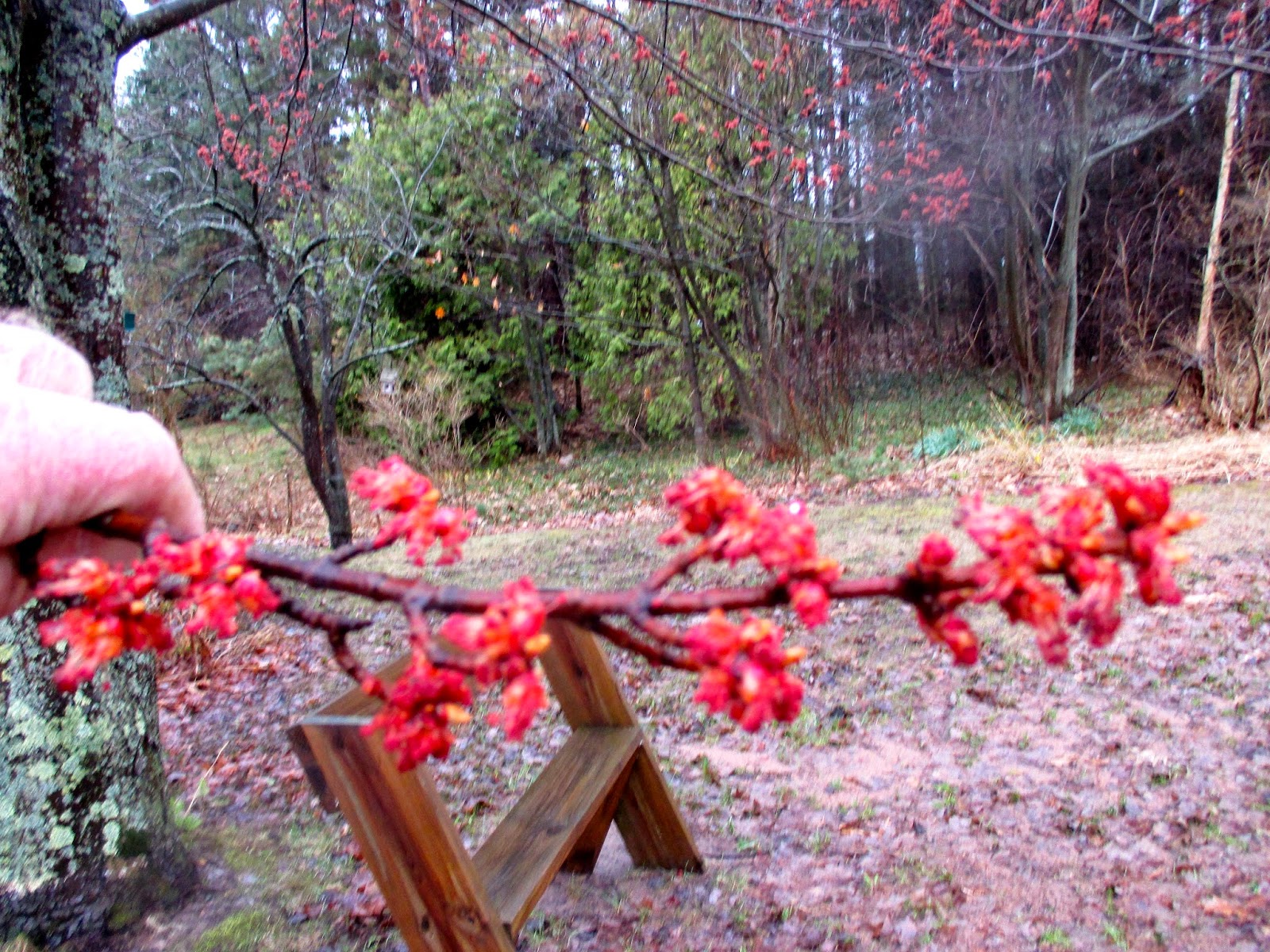
RED MAPLES; YOU'VE GOTTA LOVE 'EM!


RED MAPLE (ACER RUBRUM)
BRANCH WITH FLOWERS...

...INDIVIDUAL FLOWERS
Tuesday, 9:00 AM. 44 degrees F, up from 40 degrees earlier.  Wind WSW, light with occasional stronger gusts.  The sky is overcast with low clouds.  The humidity is 90% and the barometer is currently steady at 29.87". It rained a bit off and on during the night and it is a cold, damp day.
   Every spring I watch patiently for the red maple flower buds to swell and eventually open fully.  It is well worth the wait, as the flowers, although individually small, are brilliant maroon-red in full bloom and very attractive.  The flowers being small, the tree as a whole is not overly colorful, but close-up examination meets all expectations.
   Red maple, Acer rubrum, is a North American native tree of wide distribution, and is typically found in wet locations, but like most moisture-loving trees, it will withstand drier conditions, and makes a good street tree.  When young the tree has a very regular, oval shape, and eventually becomes a large, even majestic tree.  In my experience it is generally trouble free and stays structurally sound well into old age, and in many respects I prefer it to the more widely planted sugar maple.
   The red maple is known mainly for its brilliant red  autumn color, and in the native landscape they stand out like pillars of fire among the more subdued hues of other native trees.
   There are naturally occurring hybrids between red and silver maple, Acer saccharinum, that exhibit many of the best characteristics of both species.  'Autum Blaze' and similar popular cultivars have, unfortunately, become over-planted, and along with the planting of sugar and other maples have contributed to the overuse of the entire maple genus.
   But you've gotta love em!

Monday, May 12, 2014

"JA, JA, CHOLLY, VE GET SO SOON OLDT UND SO LATE SCHMART"

THE ARBORVITAE HEDGE WAS BADLY BROKEN AND DAMAGED BY SNOW LOAD

BUT WITH JUDICIOUS PRUNING ...

...OF DEAD AND BROKEN BRANCHES...

...AND SHEARING...

...AND SUPPORT...

...I DID A PRETTY GOOD JOB
Monday, 8:00 AM.  37 degrees F, wind NE, strong and blustery.  The sky is overcast and it is still raining and misting.  We got .8" of rain last night.  The humidity is 94% and the barometer is trending down,  now at 29.88".  It was cold enough to see my breath walking Buddy, and my hands got cold with no gloves.  A few Forsythia are starting to bloom, braving the elements.
   The first hummingbird of spring, a male, showed up right on time yesterday, looking for the feeder.  I immediately got busy and prepared the solution and got the feeders out.  I haven't seen him since but I think I heard his teeth chattering this morning (that's a figure of speach, of course).
   I saved the worst of the winter's damage repair for  last.  The white cedar, AKA arborvitae, hedge in the back yard was virtually bent bent to the ground by snow load, and it looked like a complete loss after the snow melted.  I was tempted to just cut it down, but decided to wait to see if it straightened up some on its own, and it did to a degree.  So, I decided to try to save it with some creative pruning and staking.
   In a way the whole problem was my fault.  To begin with, I planted the straight species, Thuja occidentals, because it was cheaper than buying cultivars such as 'Techny' or 'Nigra' which have stronger branching structures and therefore make better hedges.  Then, I let the plants grow too tall and narrow, because I wanted maximum height for privacy.  I should have trimmed them at least once a year to keep them from developing week, multiple stems, even if it slowed their growth in height.  As they used to say in the Milwaukee of my youth, "Ja, Ja, Cholly (Charlie) ve get so soon oldt und so late schmart!"  
   So I finally brought out the pruning tools and cut out the dead and broken branches, pruned everything back to a more stable height, and tied weak branches to stronger ones and put in a few support stakes as well.  I cut an old green T-shirt into strips for tying, the material being soft and not as likely to damage the bark as twine. Finally, I gave the whole  hedge a cosmetic shearing.
   The end result is pretty good, and I hope it will look fine after a season of new growth and another  shearing or two.  If not, I will have to take the hedge out and start over.

Sunday, May 11, 2014

HAZLENUTS, PUSSY WILLOWS, AND A PERFECTLY GOOD "WHATSIS"

BEAKED HAZELNUT MALE CATKINS...

...FEMALE FLOWER


PUSSY WILLOWS IN FULL BLOOM
AND IT WAS A BIG DUMPSTER DAY
Sunday, 9;00 AM.  41 degrees F and warming up.  Wind variable and light from the N at ground level, with scattered clouds moving in from the W at high elevation.  It is hazy over the Islands and the ice pack is still prominent southward in the channel.  The humidity is 77% and the barometer has started to trend down, now at 29.94".  Tomorrow is predicted to be cold and rainy, so this is a spring day to be savored.  There was little evidence of migrating small birds as Buddy and I strolled along this morning.  Those that were with us yesterday have evidently moved on, still seeking spring.
   Spring is finally here, ice or no ice, and lots of plants are blooming, maybe a little late but blooming none-the-less.  The native beaked hazelnuts (Corylus cornuta) are in bloom, as are the native pussy willows (Salix discolor), which are finally in full flower, the golden yellow anthers at last shedding their pollen.
   Dumpster Day was a busy success, and I made a number of trips; first the big stuff, and then odds and ends that I finally, reluctantly, decided to relieve myself of.  I maintained my self-discipline, resolutely declining to pick up that great, almost-new "whatsis" that someone else had just divested themselves of.
    However, one man's junk is another man's treasure, and the pickers were standing on the sidelines like jackals at the feast all day, ever ready to snatch that perfectly good "whatsis" before it went into the dumpster's gapping maw.

Saturday, May 10, 2014

JUST HANGIN' 'ROUND

CHANNEL ICE STILL HANGIN'  'ROUND...

...VIEW FROM THE PORCH LATE YESTERDAY AFTERNOON

Saturday,  8:15 AM.  41 degrees F but warming up quickly.  Wind SSW, variable... light to moderate.  The sky is clear for a welcome change, the humidity is down to 72% and the barometer has risen a bit to 29.88".  I saw a number of chipping sparrows flitting about in the branches on our walk and heard a lot of small bird song and I imagine that the spring warbler migration will swoop in any day now.  And, it is time to put the humming bird feeders out, as the males always arrive in Bayfield on or before May 15th.  They come to claim their territory, which if one is fortunate includes a feeder, and the females follow.  Good luck, guys!
   I have been alerted to the fact that the poet Robert Frost enunciated in poetry something akin  to what I wrote in my post of May 6th about aspen flowers, in Nothing Gold Can Stay:

Nature's first green is gold, 
Her hardest hue to hold. 
Her early leafs a flower; 
But only so an hour. 
Then leaf subsides to leaf. 
So Eden sank to grief, 
So dawn goes down to day. 
Nothing gold can stay.
   
   Today is Dumpster Day in Bayfield, the once-a-year opportunity to get rid of almost anything at no cost.  Four huge containers are parked in the public parking lots  on Washington Ave. and Broad Street.  A city crew with end loaders will be on hand to help put junk into the dumpsters.  I spent a good deal of time taking several pickup loads down yesterday to beat the rush.  It is amazing what useless, broken or outmoded stuff one can collect in a few years. 
   Meanwhile, the channel ice just won't go away, like a guest that won't leave when the party's over...reminds me of the iconic comedian Red Skelton, and the rather dim-witted character Clem Kaddidlehopper  he depicted who always started a story with, "I wasn't doin' nuttin'...I was just hangin' 'round"...

Friday, May 9, 2014

HOW TO PLANT POTTED SHRUBS

1:REMOVE SHRUB FROM CONTAINER

2: CUT OR ROUGH UP ANY GIRDLING ROOTS

3: FIND ROOT COLLAR OF SHRUB

4: PLANT AT OR SLIGHTLY ABOVE ORIGINAL DEPTH OF  SHRUB

5: BACKFILL AND WATER SHRUB

Friday, 8:30 AM.  36 degress F, wind ENE, light.  The sky is overcast and it is very foggy.  The humidity is 97% after heavy rainfall of over a half an inch last night.  The barometer stands at 29.47".
   I and Dave and Lincoln,  of Jay's Tree Care, installed the first planting job of this late season yesterday,  a continuation of the large landscape project for a new home on the lake shore.  We planted fourteen shrubs in five gallon pots along the lake side of the home.  We managed to get the shrubs (PJM Rhododendrons, Arctic Blue willows, old fashioned bridal wreaths and  a PG Hydrangea) planted, mostly in the rain.  It was a messy undertaking but turned out well.  The plants still need to have weed barrier and mulch put around them so we are not quite finished.
   Most shrubs and  small to medium sized deciduous trees and conifers are now grown and brought to market in containers.  On the whole, container grown plants perform at least as well as those grown in the ground, and they are on balance easier to store, transport and plant than bare root or balled and burlapped plants, but a few fundamental rules must be followed to insure a successful planting.
   First, remove the plant from the pot.  If the plant has become root bound in the pot, the pot may have to be cut off.
   Second, remove any girdling roots.  Container grown plants tend to become root bound in the pot.  When the plant is removed from the pot any girdling roots, those that spiral around the ball because they have grown against the pot, must be pruned off with a shears or cut with a knife. If the root ball is very mostly fine, fibrous roots those must be loosened up as well.   A good procedure is to rough up the entire circumference of the ball with a sharp knife.
   Third, find the correct planting level of the root ball by rubbing away any loose accumulation of soil and mulch at the top of the ball, until the root collar is found.  Plants grown in pots tend to have a build up of decomposing mulch that raises the level of the soil in the pot, and if this layer is not removed the plant will be planted too deep.
   Fourth,   place root ball at or slightly above the original level of the soil it is being planted in. It is always  better to plant sightly too high than too deep.  The planting hole should be generous (the planting hole in the above photo is actually a little small), so that there will be no air pockets when the soil is backfilled, and the roots have loosened soil to grow into.  Amending the soil in the planting bed is usually not necessary when planting trees and shrubs unless it is heavy clay or really sterile sand or gravel.  At this location there was enough good topsoil to mix with subsoil dug from the planting hole that no amendments were needed.
  Fifth,  soil should not be heavily compacted when backfilling around the root ball, but air pockets should be eliminated.  Water the plant in well to settle the soil.  Potted plants have been watered automatically in the nursery and usually have heavy root systems so they must be watered in well at planting and be monitored for watering until well established. On this job we planted in the rain and mud and watering was not needed.